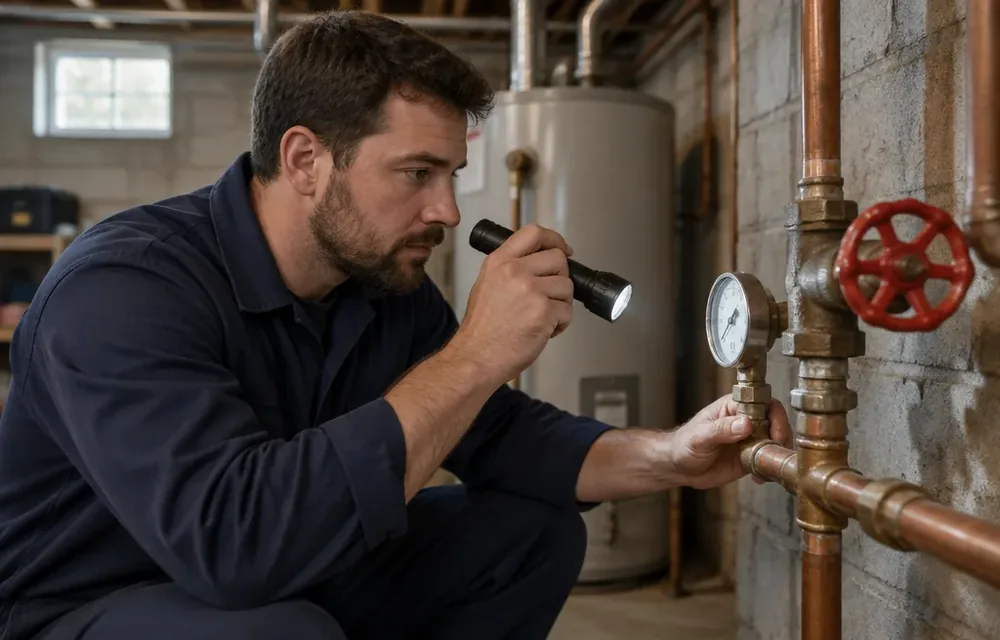
How do home water pressure and flow work?
Plain answer: street pressure pushes water into the house, and everything downstream either preserves that push or steals from it. The main shutoff, the meter, any pressure control, filters and softeners, and every length of pipe and valve sit in that chain. Pressure is the push behind the water, while flow is the volume that arrives, so a fixture can show weak flow even when street pressure is healthy if something in the chain is restricting it.
Why the distinction matters: a clogged aerator or a scaled cartridge restricts one tap while the rest of the house runs fine, which proves the street supply and the main are healthy. A half-closed main valve, a failing pressure control, a plugged whole-house filter, or a corroded supply section restricts everything past that point, so many fixtures weaken together. Sorting single-fixture trouble from whole-house trouble is therefore the first diagnostic move, because each pattern leads to a different part of the chain.
What normal looks like: healthy fixtures run steady with no sputtering, the shower holds its pattern when a second tap opens briefly, and hot and cold at one tap behave alike. Sputtering with air bursts hints at a leak drawing air or recent main work rather than a fixture fault. Hot-only weakness at several taps points to the water heater or its valves rather than the town supply. Keep these baselines in mind while testing, since the pattern matters more than any single reading.
Is it one fixture or the whole house?
Direct rule: weak flow at one tap means the trouble is at that tap, while weak flow at many taps means the trouble sits upstream where their supplies join. Test hot and cold separately at the weak tap, then test the same tap against its neighbors, then test upstairs against downstairs. This three-step comparison takes minutes and prevents replacing a faucet when the real cause is a filter two rooms away.
Single-fixture clues: a bathroom tap that dribbles while the tub beside it runs fine has a clogged aerator, a scaled cartridge, or a partially closed stop under the sink. A shower that lost its force after looking fine last month usually carries a scaled showerhead or a clogged mixing screen rather than a supply failure. Kitchen sprayers that pulse or favor one temperature point to debris in the diverter or the head. In each case the rest of the house running well is itself the diagnosis, and cleaning or renewing the fixture parts is the proportionate fix.
Whole-house clues: every tap weakening together, upstairs taps fading while downstairs holds, or hot water fading everywhere at once each implicate shared equipment. A sudden drop across the house after plumbing work often means a main or branch valve was left half open. A gradual fade over months suggests a filter loading up, a softener issue, or scale narrowing older galvanized sections. A drop paired with damp spots, hissing walls, or a spinning meter with taps closed points to a leak, and that is a call rather than a cleaning project. For running water sounds with no visible source, see leak detection and burst pipe repair.
Common causes from the tap back to the street
Short list: aerators and showerheads, fixture cartridges and stops, pressure controls, treatment equipment, hidden leaks, and the supply line cover nearly every case in that order from most to least common. Start at the tap and work backward toward the street, since the easy causes are also the frequent ones. Each check below either clears a suspect or moves you one step upstream with evidence.
At the fixture: unscrew the aerator and rinse its screen, since grit and scale collect there first and a quick rinse often restores a tap completely. Where flow stays weak with the aerator off, the cartridge or the faucet screens are scaled, and the small stop valves under the sink may be half closed or furred with mineral. Open stops fully and gently, clean or renew the cartridge with factory parts, and flush the open spout briefly before refitting the aerator so loosened debris does not plug it again.
Upstream of the fixtures: confirm the main shutoff is fully open, check any pressure control for correct behavior, and look at whole-house filters and softeners for overdue cartridges or service needs. A filter housing with a darkened or swollen cartridge is a frequent culprit for a gradual whole-house fade. Galvanized supply sections narrow from the inside with age and shed rust that plugs everything downstream, so rusty first-draw water plus weak flow implicates pipe material rather than any single fixture. Where the supply line itself is suspect, camera and pressure testing sort soil-side trouble from house-side trouble before any digging is discussed.
| Pattern you find | Where to look | First move |
|---|---|---|
| One tap weak, rest fine | Aerator, cartridge, or stop at that tap | Rinse the aerator, check stops, clean the cartridge |
| Hot weak everywhere, cold fine | Water heater valves or tank outlet | Check heater valves and ask about heater service |
| Upstairs weak, downstairs fine | Pressure control or vertical supply restriction | Check the pressure control and branch valves |
| Whole house faded gradually | Filter, softener, or aging pipe | Check treatment equipment, then test in sections |
| Sudden whole-house drop | Half-closed valve or supply event | Confirm all main valves open, then call |
Step-by-step checks any homeowner can run
The sequence: map the pattern, clean the easy parts, check the shared valves and equipment, and call with notes if the cause stays hidden. Do the steps in order without skipping, since each one rules out a layer before you touch the next. Keep a short list of which taps are weak, hot or cold, and upstairs or down, because that list is exactly what a plumber will ask for first.
Map and clean: run each tap in turn, hot then cold, and write down which combinations are weak so the pattern is visible on paper. Remove and rinse aerators and showerheads, flush the open spouts briefly, and refit the cleaned screens before judging the result. Under sinks, confirm the small stops are fully open by turning them gently to their stops without force. If one tap recovers fully after cleaning, you have found a fixture-level cause and the rest of the house needs no work.
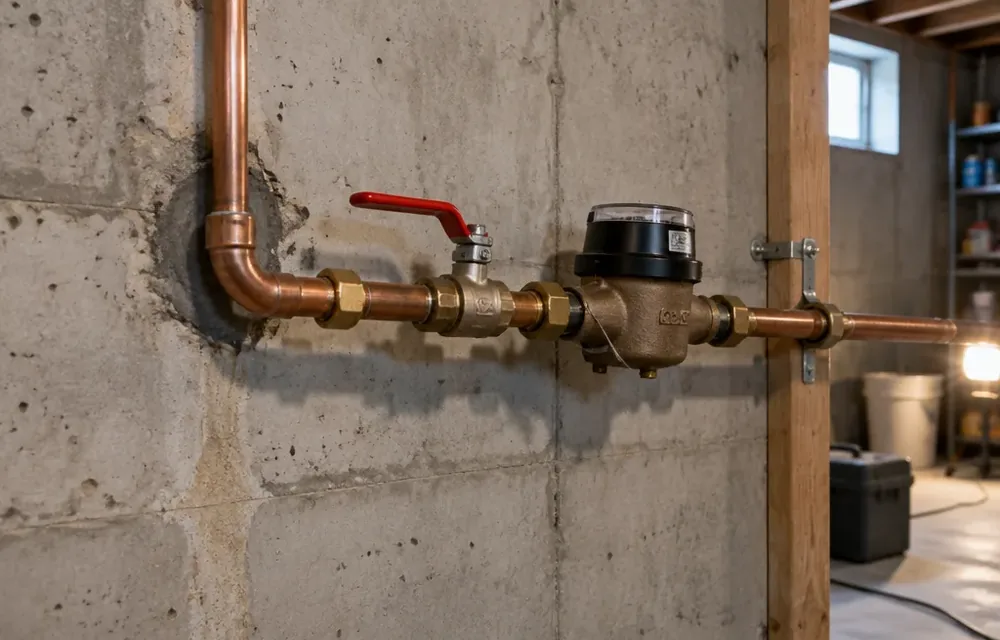
Check the shared path: find the main shutoff where the line enters, usually in the basement on the street side, and confirm it and any downstream ball valves are fully open. Look at the pressure control and any filter or softener for service lights, bypass positions, or cartridges past their change point, and switch treatment units to bypass briefly only if you know the valve positions. Never force a stuck main valve, and never open a meter pit or street valve yourself. If the meter spins with every tap closed, close the house main and call, since meter movement with no fixtures running means water is going somewhere it should not.
Why pressure trouble looks this way around Chelmsford
Local answer: mixed pipe metals, mineral-bearing water, mature street trees, and older treatment setups combine to restrict flow in Chelmsford-area homes. Copper patched into older galvanized sections corrodes at the transitions and sheds rust downstream, scale films coat cartridges and heater outlets, and root-disturbed soil shifts exterior supply ground. A house that loses flow gradually over seasons is usually showing one of these local patterns rather than a town supply problem.
Neighborhood patterns: colonials near the Center often carry galvanized branches behind newer fixture updates, so new cartridges plug with rust within weeks while the pipe keeps shedding. Capes and ranches with addition baths run long supply branches where sediment settles and feeds the farthest fixture the dirtiest water first. Streets in Lowell, Billerica, and Westford share the mineral and mixed-metal pattern, while homes near Acton and Concord on well-influenced supplies add sediment loading that shortens filter and valve life. Where a softener or filter serves the house, its service state belongs at the top of the suspect list.
Heater and treatment angle: shrinking hot-water windows plus hot-only weakness implicate the water heater outlet, its shutoff valves, or scale at the tank, and heater service belongs in the plan rather than another faucet part. Compare options in water heater installation and repair when age and noise join the pressure complaint. Where grit at aerators keeps returning across many taps, water treatment and filtration service stops the cycle by treating the cause instead of cleaning its symptoms every few months.
What not to touch and which mistakes make it worse
Firm boundary: clean screens and check valve positions, but leave stuck valves, the meter, pressure control internals, and any pipe opening to a plumber. Forcing a frozen main valve can snap the stem and start the very flood you were trying to avoid. Opening a pressure control or a supply joint without isolation and testing turns a diagnostic visit into water damage, and chemical cleaners poured into supply-side trouble do nothing except create a hazard for the person who opens the line.
Common missteps: replacing a faucet before rinsing its aerator, swapping a showerhead while the mixing valve screen stays plugged, and cranking a pressure control upward to mask a restriction all waste money or risk damage. Raising a pressure setting against a downstream blockage strains supply hoses, fill valves, and heater relief paths without fixing the weak tap. Skip the temptation to keep opening things wider, and instead narrow the pattern with the tests above so the fix lands on the true restriction.
Renters and shared buildings: in multi-unit buildings, check with neighbors before touching anything shared, since a whole-stack pressure change often traces to building equipment or town-side work rather than one apartment. Note the timing, whether hot or cold is affected, and whether other units see the same change. Building managers need that pattern more than they need a description of one tap, and town-side events usually resolve across the building at once.
When to call a plumber in Chelmsford
Clear rule: call when the whole house drops suddenly, the meter moves with taps closed, water looks dirty, or any valve you need is stuck. Those signs mean the trouble sits in shared piping or the supply path rather than a cleanable screen. Call (978) 592-1168 with your tap-by-tap notes, including which fixtures are weak and whether hot, cold, or both are affected.
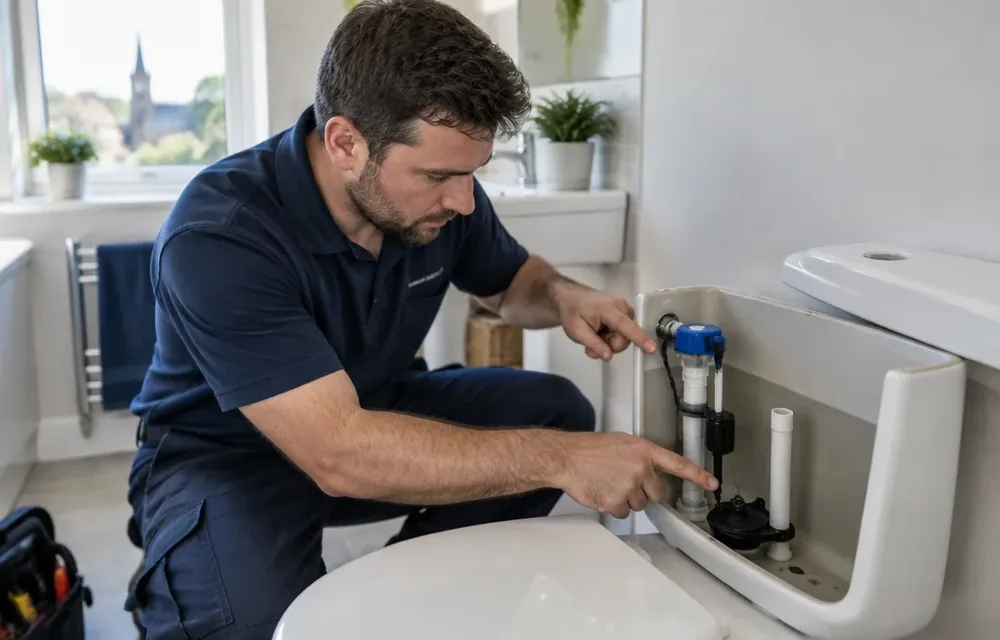
What helps on the call: report when the change started, whether it was sudden or gradual, what you already cleaned or checked, and any damp spots, hissing, or staining you have noticed. Mention the age and material of visible supply piping if you know it, plus the service state of any filter or softener. If running toilet trouble or a rumbling heater overlaps the pressure complaint, say so, since combined symptoms steer testing toward supply branches and heater outlets.
What testing looks like: expect section-by-section checks that isolate fixture trouble from shared-piping trouble, with pressure readings compared across hose bibbs and branches. Sound fixtures get cleaned or renewed with the branch flushed before refitting, while shared-side causes get traced to the valve, control, treatment unit, or pipe section at fault. The visit should end with the restriction named, the choices laid out in plain terms, and flow retested at the taps you flagged.
Near you
When to call
Related guides
Frequently asked questions
Why is water pressure low at only one faucet?
A single weak tap almost always has a clogged aerator, a scaled cartridge, or a partially closed stop valve. Remove and rinse the aerator first, then check the stops under the sink and the cartridge if flow stays weak. The rest of the house running well proves the main and street supply are healthy, so the fix stays at that one fixture.
Why is hot water pressure low everywhere but cold is fine?
Hot-only weakness across many taps points to the water heater outlet, its shutoff valves, or scale at the tank rather than the town supply. Check that the heater valves are fully open and note any rumbling or shrinking hot-water windows. Heater service or replacement planning, rather than faucet parts, is the proportionate next step when age and noise join the complaint.
Can a whole-house filter cause low water pressure?
Yes, a loaded filter cartridge or a softener overdue for service is one of the most common causes of a gradual whole-house fade. Treatment equipment sits across the full supply, so a restriction there weakens every tap at once. Check service indicators and cartridge condition, and judge pressure again after proper service before suspecting pipes.
My meter spins with all taps closed. What does that mean?
A meter that moves with every fixture off means water is leaving through a leak, a running toilet, or an open line somewhere past the meter. Close the house main and see whether the movement stops, which separates house-side trouble from street-side trouble. Call for help rather than opening walls or the meter pit yourself, and keep water use off until the path is found.
Still stuck?
Describe what you see when you call and a local specialist will guide the next step.